
TL;DR: A licensed plumber charges $150–$350 in labor to swap a toilet, and the fixture itself runs $100–$600 depending on the model. Total installed cost for a standard replacement lands between $275 and $675 for most homes. If your toilet is running, rocking, or flushing weakly, a $25–$60 fill valve or flapper repair often fixes it, full replacement only wins when the porcelain is cracked, the toilet is pre-1994, or repairs have already been done twice.
Your toilet is either running constantly, wobbling on the floor, or cracked, and you’re trying to figure out whether you’re looking at a quick repair or a full swap before calling anyone. Here’s the breakdown: repair parts cost $10–$80 and take under an hour; a full replacement runs $275–$675 installed and takes 1–2 hours. The decision point is usually the fixture’s age and how many times you’ve already fixed it. Read through this and you’ll know which path makes sense before you pick up the phone.
How much does toilet replacement cost in 2026?
Toilet replacement costs $275–$675 installed for a standard residential swap, combining fixture cost and plumber labor. That range covers the most common scenario: a builder-grade or mid-range toilet in a home with a standard 12-inch rough-in, no flange damage, and no supply line issues.
Here’s how the numbers break down:
Fixture cost (what you pay at the supply house or big-box store):
- Builder-grade single-flush (1.28 gpf): $100–$180
- Mid-range two-piece (Kohler, American Standard, TOTO): $180–$350
- One-piece or comfort-height models: $300–$600
- High-efficiency WaterSense-certified models: $150–$500 (overlaps with mid-range)
Labor cost:
- Standard toilet swap (remove and set, same rough-in): $150–$300
- If the wax ring needs a double stack or the flange sits below the finished floor: add $30–$60
- Flange repair or replacement (cracked or corroded): add $75–$175
- Shut-off valve replacement (common on older installs): add $50–$100
If you’re in a home with a non-standard rough-in, 10-inch or 14-inch instead of the common 12-inch, you’ll need a specific fixture, which can add $50–$150 to the fixture cost. Measure from the wall (not the baseboard) to the center of the floor bolts before you shop.
For a deeper look at what plumbers charge by the hour in this area, see our post on how much a plumber costs per hour in Bakersfield.
What’s the labor cost to replace a toilet specifically?
Plumber labor to replace a toilet runs $150–$350 for a standard swap, typically billed as a flat service rate rather than hourly. Most straightforward replacements take 1–2 hours including haul-away of the old unit.
What pushes labor cost up:
- Flange damage: A cracked or corroded closet flange needs repair before the new toilet sets. Cast-iron flanges in older homes are especially prone to this. Budget $75–$175 extra.
- Corroded supply line or shut-off valve: If the angle stop won’t close fully or the braided supply line is original to the house, a plumber will replace both while they’re there. That’s $50–$100 more.
- Toilet location: A tight powder room or a toilet backed against a wall with limited access takes longer to work in.
- Haul-away: Most plumbers include old-fixture disposal in the flat rate. Confirm this before booking.
A written quote should itemize: labor (flat or hourly), the fixture if the plumber is supplying it, any parts (wax ring, supply line, bolts), and haul-away. If a quote is verbal only, ask for it in writing.
When is a repair cheaper than replacing the toilet?
A toilet repair is almost always cheaper than replacement when the porcelain itself is intact and the toilet is less than 20 years old. The most common fixable problems cost $25–$120 in parts and under an hour of labor.
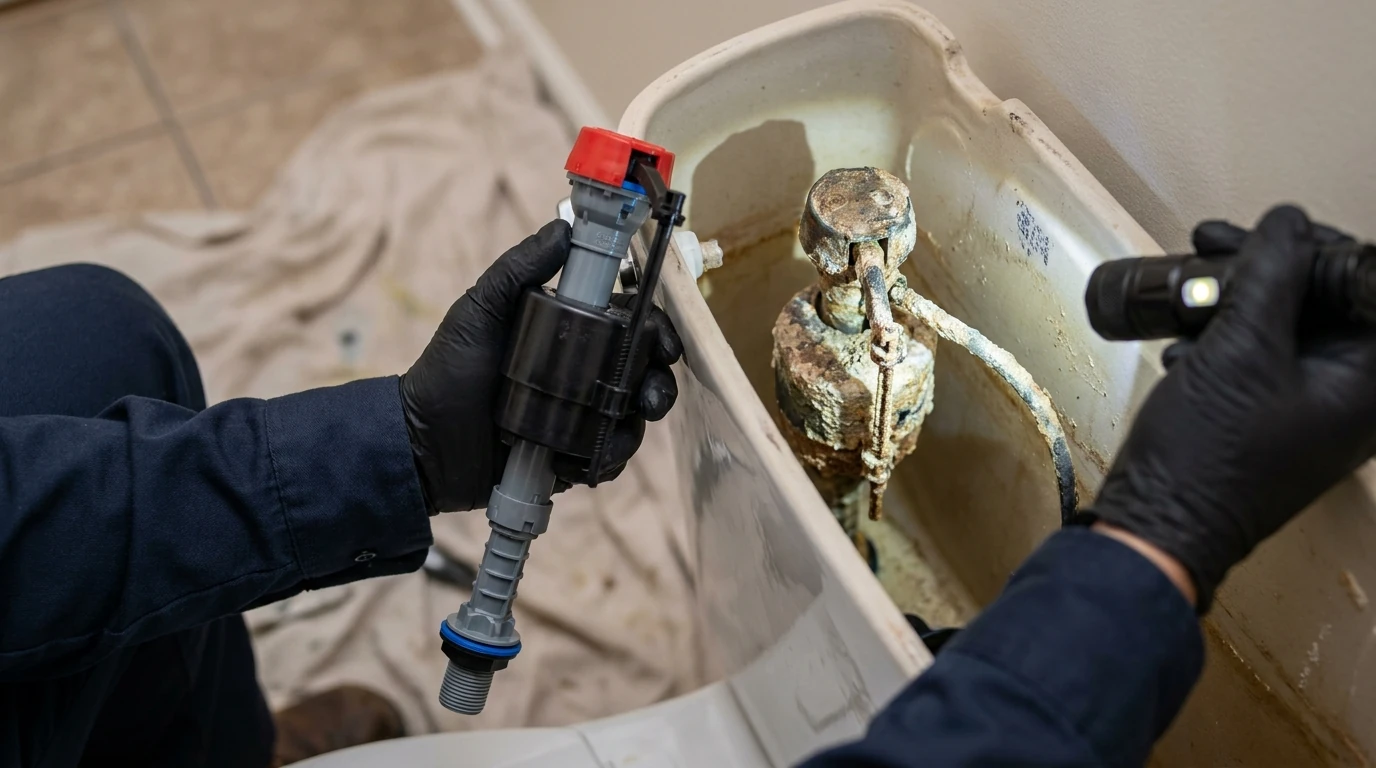
Fill valve replacement: A running toilet that hisses or runs between flushes usually has a failed fill valve. A Fluidmaster 400A or equivalent costs $12–$18 at any hardware store and takes 20 minutes to swap. Plumber labor to do it: $75–$125 flat.
Flapper replacement: A toilet that runs intermittently (the phantom flush) almost always has a warped or mineral-scaled flapper. A replacement flapper costs $5–$15. This is the most DIY-friendly fix in plumbing.
Fill valve AND flapper together: If both are worn, a complete rebuild kit runs $20–$35 in parts. Plumber labor: $85–$140.
Loose or rocking toilet: Usually a failed wax ring or loose floor bolts, not a reason to replace the toilet. A plumber resets the toilet with a new wax ring for $100–$175.
The repair-vs-replace fork: Replace the toilet when:
- It’s a pre-1994 model using 3.5–5 gallons per flush (gpf). Modern 1.28 gpf toilets will cut water use significantly.
- The porcelain has a crack at the base or tank, not a surface scratch, an actual structural crack.
- You’ve already replaced the fill valve and flapper and it’s still running.
- The flange is so damaged that the repair cost approaches the cost of a new fixture.
Hard water accelerates this timeline. Bakersfield’s municipal water consistently ranks among the hardest in California, and mineral scale builds up inside fill valves and flappers faster than in soft-water areas. If you’re replacing the same fill valve every 3–4 years, that’s a signal that a full replacement with a quality fixture, and possibly a whole-house softener, makes more long-term sense. Learn more about water softeners and filtration options if scale is a recurring problem.
Is it worth replacing an old toilet for water savings?
Replacing a pre-1994 toilet with a WaterSense-certified model saves roughly 13,000 gallons per year for a family of four, according to the EPA’s WaterSense program. That translates to real money on a Bakersfield water bill.
Pre-1994 toilets use 3.5–5 gpf. The federal standard since 1994 is 1.6 gpf. WaterSense-certified models use 1.28 gpf or less and must meet flush performance standards, so high efficiency doesn’t mean weak flushes.
At average California residential water rates, the savings from swapping one pre-1994 toilet can offset the cost of the new fixture in 3–5 years, not counting any utility rebates. Check with the City of Bakersfield’s water utility for current rebate programs, rebates on WaterSense fixtures have been available in Kern County in past years and are worth a quick call before you buy.
If your home still has original toilets from the 1970s or 1980s, the water-savings math almost always favors replacement, even if the toilet is still technically functional.
What should you do next?
If your toilet is running, start with the fill valve and flapper, those two parts cover 80% of running-toilet complaints and cost under $35 in parts. If it’s rocking, a plumber should reset it before the wax ring fails completely and water gets under the floor. If the porcelain is cracked or the toilet is pre-1994, replacement is the right call.
For a toilet that needs a full replacement, get a written quote that separates fixture cost from labor, confirms haul-away is included, and notes whether the shut-off valve and supply line are being replaced. A reputable plumber will inspect the flange condition before setting the new toilet, if that step isn’t mentioned, ask about it.
All Pro Plumbing Heating and Air handles toilet repairs, toilet replacements, and flange repairs across Bakersfield and the surrounding area, available 24/7. To schedule a toilet inspection or request a quote, call (661) 863-9242 or visit our toilet and fixture repair service page.
About All Pro Plumbing Heating and Air
All Pro Plumbing Heating and Air is a licensed plumbing and HVAC contractor serving Bakersfield, CA and surrounding communities (license #960566). Available 24/7, their technicians handle toilet and fixture repairs, drain cleaning, water heaters, gas lines, slab leaks, repiping, and full heating and air conditioning service across Kern County. For service or a written quote, call (661) 863-9242.