TL;DR: A good plumber holds a valid state contractor license (verifiable online in seconds), carries workers’ compensation and general liability insurance, provides a written itemized estimate before touching anything, and can explain what they found and why the repair costs what it does. In California, that license is issued by the CSLB. Any contractor who can’t hand you a license number, hedges on insurance, or quotes a price verbally and moves on is worth skipping.
You found water pooling under the water heater at 9 p.m. on a Tuesday. Or a drain that’s been slow for weeks finally stopped moving. Either way, you’re now searching for a plumber you’ve never used, with no idea whether the first result on your phone is a licensed professional or someone with a truck and a wrench. Here’s how to sort them out fast, before anyone opens a wall or quotes you a price.
Does the plumber hold a valid California contractor license?
In California, anyone performing plumbing work for compensation on a job over $500 (combined labor and materials) must hold a license from the California Contractors State License Board (CSLB). The relevant classification for plumbing is C-36. You can verify any contractor’s license number, current status, and bond information in about 30 seconds using the CSLB license check tool.
Ask for the license number before scheduling. Then look it up yourself. You’re checking three things: the license is active (not expired or suspended), the classification matches the work (a C-36 for plumbing, a C-20 for HVAC), and the name on the license matches the company name you were given. A mismatch on any of those is a reason to ask a follow-up question before you go further.
Unlicensed contractors are not covered by CSLB’s consumer protection programs. If the work causes damage or goes unfinished, your recourse is limited to small claims court rather than a formal complaint and recovery fund.
Does the contractor carry workers’ compensation and general liability insurance?
A licensed contractor should carry two types of coverage: general liability (which covers damage to your property during the job) and workers’ compensation (which covers their crew if someone is injured on your property). Ask for a certificate of insurance and confirm it’s current.
This matters more than it sounds. If an uninsured worker slips on your wet floor during a water heater swap, your homeowner’s policy may be the one that responds. That’s a claim you don’t want to file for someone else’s job.
Some solo operators are legitimately exempt from workers’ comp if they have no employees, but they should be able to explain that clearly. Vague answers or resistance to the question are warning signs.

Will the plumber provide a written, itemized estimate before starting?
Yes, a reputable plumber will give you a written estimate. It should list the scope of work, the specific materials to be used (pipe type, fitting brand, equipment model number for a water heater or fixture), labor cost, and any conditions that could change the price (like finding corroded fittings behind the wall once access is opened).
A verbal quote is not an estimate. “Around $400” with nothing in writing is not a contract. California law requires a written contract for home improvement work over $500. If a contractor starts work without one, that’s a violation of state law, not just a bad business practice.
Before signing anything, read the change-order clause. A legitimate estimate will describe how additional costs get approved: in writing, before the extra work begins. Any contract that allows the contractor to add charges at their discretion without your sign-off is worth renegotiating.
How many plumbing quotes should you get?
For non-emergency repairs under $500, one or two quotes is usually enough. For larger jobs (a water heater replacement, a sewer line repair, a whole-house repipe), get at least three written estimates.
Three quotes let you see the middle of the market. The lowest bid is worth scrutinizing: is it lower because they’re more efficient, or because they’re cutting corners on materials or skipping permits? The highest bid deserves the same question in reverse. Ask each contractor to walk you through their scope line by line. The one who can explain their numbers clearly is usually the one who knows what they’re doing.
For emergency situations, you may not have time for three quotes. In that case, verify the license, ask about the written estimate, and ask directly: “Is this a flat-rate price or time-and-materials?” Flat-rate means the price is fixed for the described scope. Time-and-materials means the clock is running and materials are marked up. Both are legitimate, but you need to know which one you’re agreeing to.
For a deeper look at what plumbers charge in this area, see How Much Does a Plumber Cost Per Hour in Bakersfield? (2026 Price Ranges).
What are the signs of a bad plumber?
Several patterns show up consistently with contractors who do poor work or operate unethically.
No license number on request. A licensed contractor knows their number. Hesitation or a promise to “email it later” is a red flag.
Pressure to decide immediately. Urgency tactics (“I can only hold this price for the next hour”) are designed to prevent you from getting a second opinion. Real plumbers are busy; they don’t need to pressure you.
Cash-only, no receipt. Cash is fine. No receipt is not. Every transaction should produce a paper trail.
Pulling no permits. Permitted work gets inspected, which protects you when you sell the house and when something goes wrong. A contractor who suggests skipping the permit to “save money” is offloading risk onto you.
Vague scope of work. “Fix the leak” is not a scope. A good plumber tells you what pipe, what fitting, what repair method, and why.
Diagnosing without looking. A plumber who quotes a price before seeing the problem is guessing. A slab leak under a Bakersfield foundation, a root-intruded sewer lateral in an older East Bakersfield neighborhood, a failing anode rod in a hard-water area, these all look different and cost different amounts to fix. The diagnosis comes first.
Should you ask about permits and inspections?
For most plumbing repairs (fixing a leaky faucet, replacing a toilet, clearing a drain), permits are not required. For work that changes the system (water heater replacement, gas line work, sewer line repair, repiping), a permit is typically required by the local building department.
Ask your contractor directly: “Does this job require a permit?” If yes, ask who pulls it. The contractor should pull their own permit, not ask you to do it. A homeowner-pulled permit on contractor work is a workaround that can void your homeowner’s insurance and create problems at resale.
Permitted work is inspected by the city or county building department. That inspection is independent verification that the work was done correctly. It’s worth the small additional cost and scheduling delay.
What questions should you ask before work begins?
Beyond license and insurance, these questions help you understand who you’re hiring and what you’re agreeing to.
- How long have you been doing this type of work? Experience with a specific repair type matters. Slab leak detection and rerouting is different from a water heater swap.
- Who will actually do the work? Some contractors sell the job and send a subcontractor. Know who’s showing up.
- What happens if you find something unexpected? The answer should be: we stop, we show you what we found, we give you a written change order, and you approve it before we continue.
- How do you handle cleanup? Professional plumbers bring drop cloths, wear shoe covers in finished spaces, and haul away old equipment.
- Do you warranty the work? A standard labor warranty is one year. Materials are typically covered by the manufacturer. Get the warranty terms in writing.
- Are you familiar with the local water conditions here? Bakersfield’s municipal water is among the hardest in California. A plumber who services this area regularly will know that scale accelerates water heater failures, clogs aerators, and shortens fixture life. That context shapes good repair and replacement recommendations.
For emergency situations specifically, Best Emergency Plumbing Company in Bakersfield, CA: What To Look For (and Who Delivers) covers what to look for when you can’t wait.
What should you do once you’ve found a contractor you trust?
Get everything in writing before work starts. Keep a copy of the signed contract, the permit number (if applicable), and the final invoice. Take photos of the completed work before walls are closed up. Register any new equipment (water heaters, fixtures) for the manufacturer warranty yourself, in your name.
A good working relationship with a licensed plumber is worth maintaining. Once you’ve vetted someone and had a good experience, note their license number and contact information for future calls. The vetting process takes 20 minutes the first time. After that, you already know who to call.
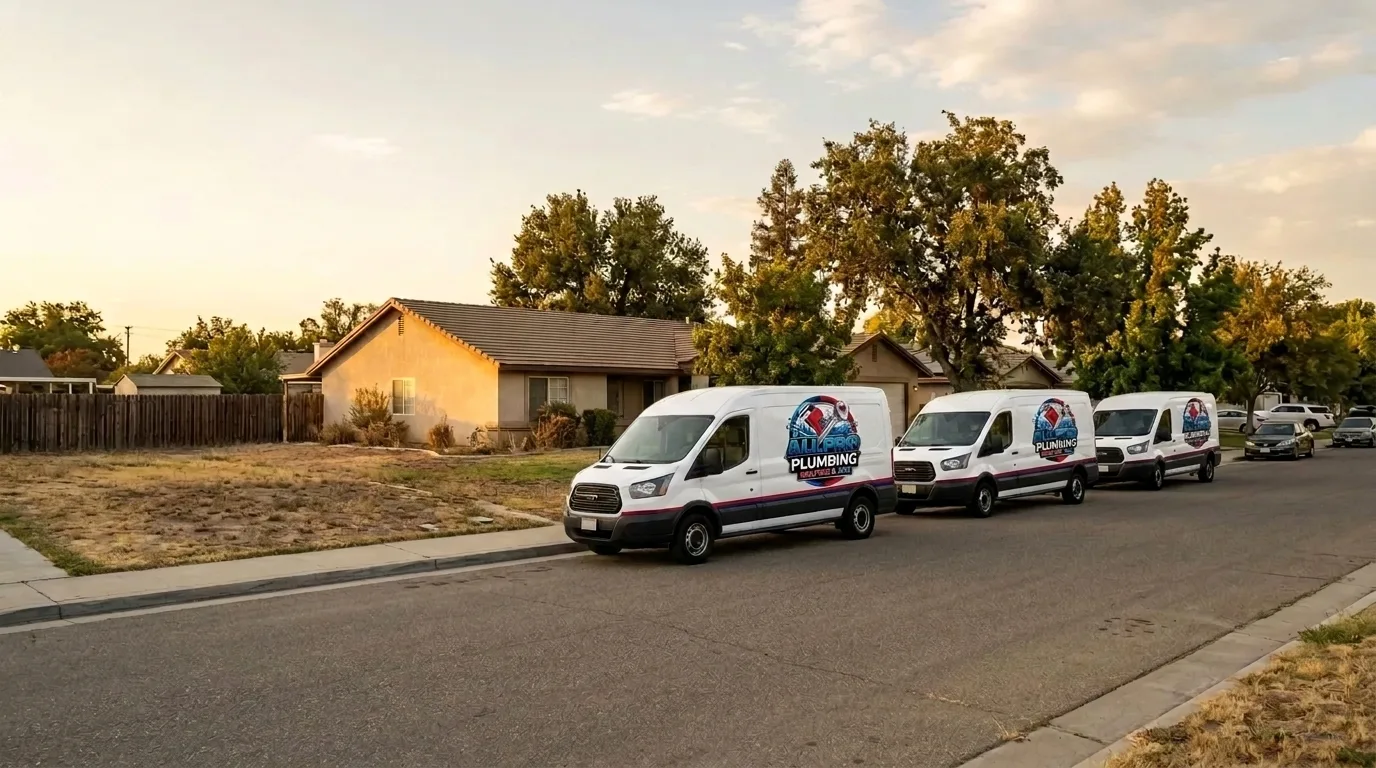
All Pro Plumbing Heating and Air serves Bakersfield and the surrounding area with plumbing, heating, and air conditioning services. If you’re ready to schedule a repair or request a written estimate, you can reach the team directly at (661) 863-9242.
About All Pro Plumbing Heating and Air
All Pro Plumbing Heating and Air is a licensed plumbing and HVAC contractor serving Bakersfield, CA and surrounding Kern County communities (license #960566). Their technicians handle emergency plumbing, drain cleaning, sewer line repair, water heater service, leak detection, slab leak repair, repiping, gas line work, and full heating and air conditioning service across the region. The company operates 24/7 for plumbing and HVAC emergencies.