TL;DR: If your garbage disposal is clogged in Bakersfield, shut off the wall switch and the breaker first, then try the reset button and a hex key before anything else. A unit that hums but will not spin is usually jammed, not dead. If standing water stays in the sink after bailing, or the hex key will not budge, call a licensed plumber. Most jams clear in under an hour; a real drain-line clog or a failed motor needs a professional look.
If you just flipped the wall switch and your disposal answered with a low hum instead of its usual grind, or the sink is sitting full of gray water over a sink full of potato peels and coffee grounds, you are dealing with one of two things: a jammed flywheel or a clog further down the line. Bakersfield’s hard water doesn’t help either case. Mineral scale builds up on the flywheel and splash guard over years, which is why disposals here tend to jam a little earlier than the manufacturer’s spec sheet suggests. Here is what to try before anyone picks up a phone, and what tells you it is time to.
Why does my garbage disposal hum but not spin?
A disposal that hums but will not turn is almost always jammed against the flywheel, not electrically dead. The motor is getting power but something, usually a fruit pit, a fork tine, or compacted fibrous scraps, is physically blocking the blades from rotating.
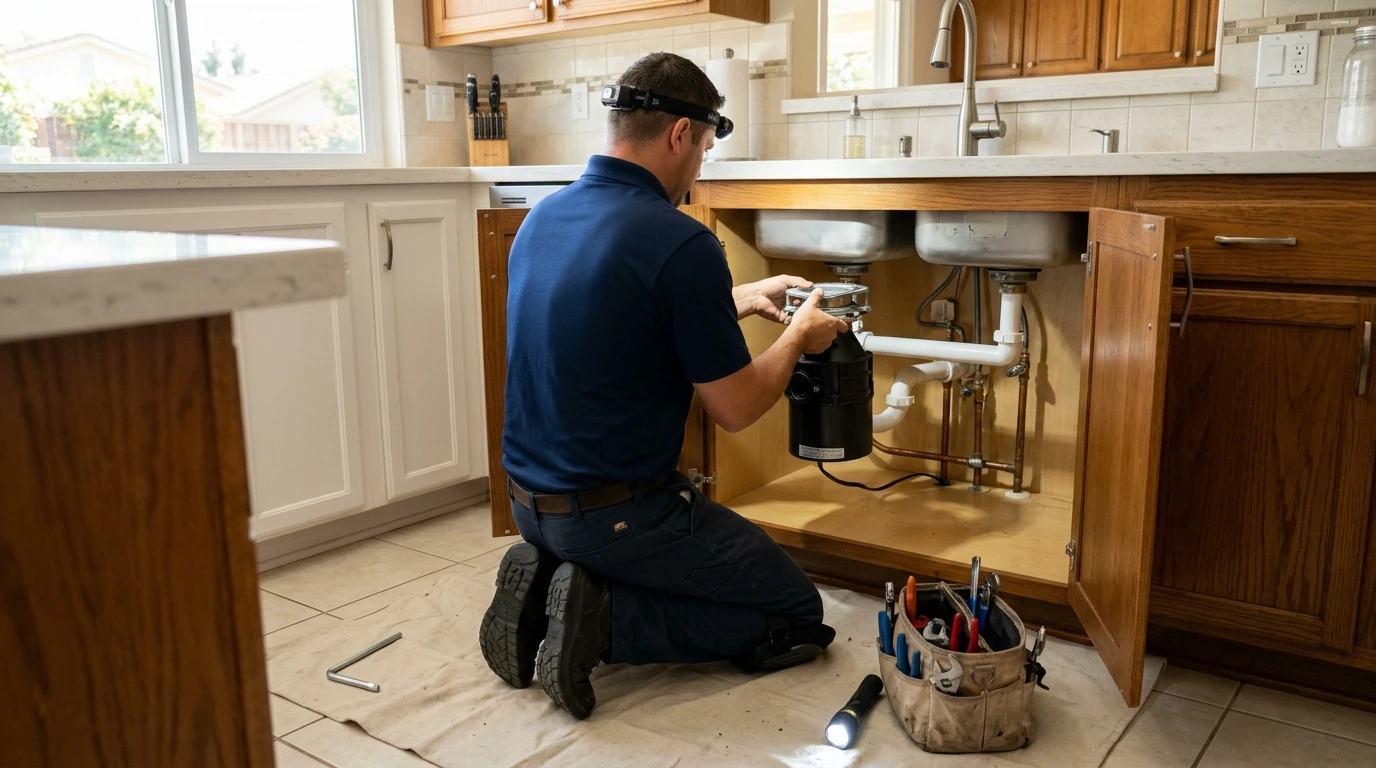
First, flip the wall switch off and cut power at the breaker. Never reach into the disposal with your hand, even with the switch off. Look underneath the unit for a small hex-shaped hole (most disposals have one) and work a 1/4-inch hex key back and forth until the flywheel turns freely. Once it spins without resistance, restore power and press the red reset button on the bottom of the unit. It will click when it resets.
If the hex key will not move at all, or the unit trips the reset button repeatedly after you clear it, something is jammed harder than a wrench can fix, or the motor itself has burned out. That is a sign to stop forcing it.
What do I do about a sink full of water behind a clogged disposal?
Stop running water into the sink immediately and bail out what is already standing there. Standing water in the basin after you have shut things down usually means the clog is downstream of the disposal, in the drain trap or the branch line, not inside the unit itself.
Use a cup or small bucket to remove the water rather than letting it sit. Check under the sink for any drips at the trap fittings, since a full basin puts extra pressure on every joint below it. If the water drains slowly on its own after a few minutes, you likely have a partial line blockage rather than a hard stop.
If the sink overflowed before you caught it and water reached the cabinet floor or the particleboard under the sink, dry what you can with towels now. Standing water against cabinet wood swells it fast, and if it sat for more than a few hours, our sister company, ProRestoration Services, handles the drying and any rebuild so you are not hiring a second contractor to chase mold later.
What should never go down a garbage disposal?
Grease, rice, pasta, and potato peels are the most common causes of disposal clogs, because they either expand with water or coat the blades and drain walls with a film that hardens. None of these belong in a disposal, even in small amounts.
Fats, oils, and grease (often called FOG) are liquid when hot and solid when cold. Poured down a warm disposal, they coat the chamber and the pipe behind it, then congeal into a waxy plug once the water cools. The EPA flags FOG as one of the leading causes of residential and municipal sewer blockages for exactly this reason (https://www.epa.gov/). Rice and pasta keep absorbing water after they go down and swell inside the trap. Potato peels and other starchy, fibrous scraps turn into a paste that wraps around the flywheel instead of grinding clean.
Stringy produce like celery and corn husks, coffee grounds in volume, and bones all cause the same kind of trouble. Run cold water, not hot, while the disposal is grinding, and let it run another 15 to 20 seconds after the food is gone to flush the line.
Is the clog in the disposal unit or the kitchen drain line behind it?
The disposal and the drain line are two different problems with two different fixes, and it is worth telling them apart before you call anyone. If water backs up only when the disposal runs, suspect the unit. If water backs up even when the disposal is off and you are just running the faucet, the clog is in the drain line past it.
A quick test: with the disposal off, run water directly down the other side of a double sink, or down a different fixture on the same drain line, like the dishwasher. If that backs up too, the blockage is downstream in shared pipe, not inside the disposal chamber. We cover that scenario in more detail in our guide to a kitchen sink clogged in Bakersfield, including what a plumber actually does to clear a shared drain line versus just the disposal unit.
Should you repair or replace a garbage disposal?
Most garbage disposals last 8 to 12 years, and a unit that age or older is usually worth replacing rather than repairing once it jams repeatedly or starts leaking at the base. A new mid-grade disposal typically costs less installed than a second or third service call on a unit already past its expected life.
Signs it is a replacement, not a repair: water dripping from the bottom of the unit itself (the seal has failed, not the plumbing above it), a burning electrical smell, a motor that trips the reset button within minutes of clearing a jam, or visible rust at the mounting ring. If the unit is under five years old and this is its first real jam, clearing the obstruction and resetting it is usually all it needs.
When should you call a plumber instead of doing it yourself?
Call a plumber when the hex key will not turn the flywheel, the reset button will not hold, or water keeps backing up after you have cleared what you can reach. Those are signs of a mechanical failure or a line clog past the point a homeowner can safely reach.
A leak at the base of the disposal, a burning smell, or standing sewage-tinged water are reasons to stop immediately rather than keep troubleshooting. All Pro Plumbing Heating and Air answers calls 24/7 across Bakersfield, from Oleander to Riverlakes Ranch, and a technician can clear the unit, trace it to the drain line if the problem is further back, or swap in a new disposal the same visit if the old one has failed.
One call does it all here: the same crew that diagnoses the disposal also handles the drain line behind it and any faucet or fixture work the cabinet needs while it is already open. If you want a second set of hands before it gets worse, schedule a garbage disposal repair or request drain cleaning and we will sort out which one you actually need.
About All Pro Plumbing Heating and Air
All Pro Plumbing Heating and Air is a licensed plumbing, heating, and air contractor serving Bakersfield, CA and Kern County (California contractor license #960566), available 24/7 for plumbing calls. This post was written with the All Pro team, led by Jack Bispo. The company holds a 5.0 Google rating from local customers and partners with sister company ProRestoration Services for any water damage cleanup, so homeowners never need a second contractor for a single job.
Need help now? Call All Pro Plumbing Heating and Air at (661) 863-9242.